
The Era of Strict Enforcement — 2025 EV Charging Regulations
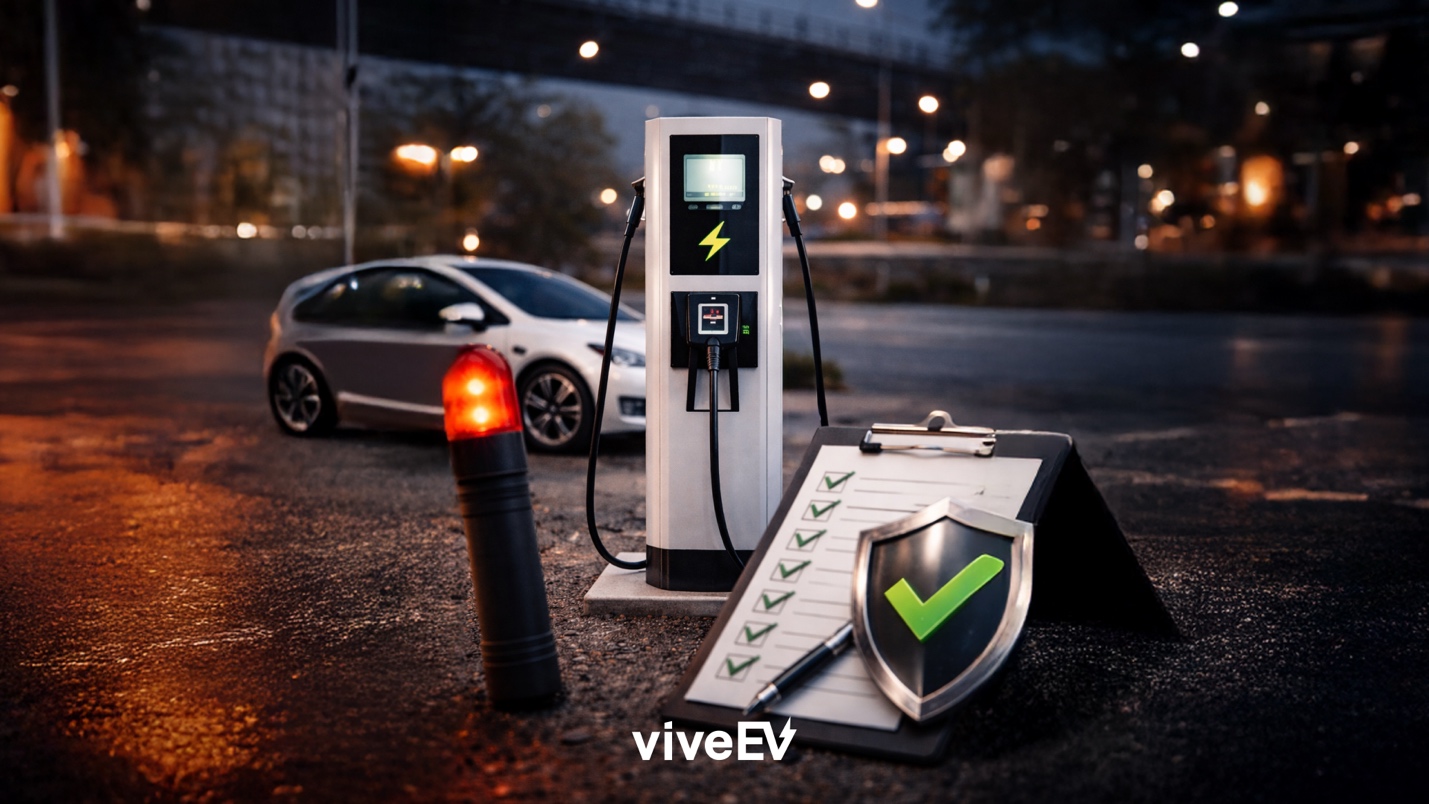
Regulations are not a 'Risk', but a 'Filter' for Market Entry.
In the second half of 2025, the regulatory environment of the global EV charging infrastructure market has entered a clear turning point. Regulations are moving from “Guidance” to “Enforcement”, and charging infrastructure that fails to meet these standards is structurally being excluded from subsidy, permitting, and bidding markets.
Regulations have become a Filter that determines market entry, no longer just a reference point. In this 4th week of December Market Lens, we summarize the key changes in global EV charging regulations in 2025 and a practical checklist for 2026, based on reliable media reports and official statutes.
Part 1. What 'Really' Changed in 2025?
1. USA | NEVI: Shifting from “Installation Subsidies” to “Operational Performance Regulation”
The nature of the US NEVI program has clearly changed starting in 2025. The Washington Post reported in August 2025 that the US government is “reinventing the EV charger project... structure to focus on operational performance rather than just installation expansion.” Behind this report is the NEVI Revised Interim Final Guidance released by the Federal Highway Administration (FHWA) on August 13, 2025. Additionally, a Congressional Research Service (CRS) report in June 2025 clarified that NEVI is being reorganized to include potential subsidy clawbacks for underperformance.
Core Change: NEVI is no longer an "Install & Get Paid" program.
97% Uptime: Requires 24/7 operational capability and continuous proof of ~97% uptime.
Stricter Downtime: Payment errors, communication failures, and software issues are all counted as downtime.
2. EU | AFIR: Elevating Charging Infrastructure to ‘Consumer Protection Regulation’
In Europe, the nature of regulation is even clearer. AFIR (EU Regulation 2023/1804) defines charging stations as public service infrastructure, not just energy facilities. AFIR has been fully applicable since April 13, 2024, and as of 2025, Member States are implementing strict supervision and penalty rules for non-compliance. The European Commission specifies AFIR as “mandatory regulation to ensure consumer access and price transparency.” "App-only payment" or "Membership-only models" are losing their place in the public infrastructure domain.
Key Points of AFIR Enforcement (DC Chargers ≥ 50kW):
Mandatory Ad-hoc Payment: Must provide payment methods available without membership (e.g., card readers).
Price Transparency: Clearly display kWh unit price and fee structure before charging starts.
Open Data: Obligation to provide public data on charger location, availability, and pricing.
3. Tech Regulation | The Standard for Hardware Safety & Interoperability
Beyond basic functionality, the 2025 market demands 'Verified Safety and Interoperability'. Compliance with design standards for safety and seamless connectivity is now a prerequisite for public tenders.
Safety Compliance: Compliance with UL2202 (DC Charging Equipment) and IEC 61851 (General EV Conductive Charging) is essential for market entry in North America and Europe.
Stable Connectivity: Support for OCPP 1.6 for reliable network operations and ISO 15118 for future scalability is now a critical evaluation criterion.
Part 2. Practical Compliance Checklist for 2026
✅ 1. Payment System (Core AFIR Requirement)
Do chargers ≥50kW provide Ad-hoc payment methods for non-members?
Is the kWh unit price clearly displayed before charging starts?
Can payment errors be remotely resolved?
✅ 2. Operational Performance Management (Core NEVI Requirement)
Is the structure capable of 24/7 operation year-round?
Is Uptime monitored and recorded in real-time?
Is there a system to tally downtime including payment/communication failures?
✅ 3. Global Safety & Tech Standards
Does the hardware comply with UL2202 / IEC 61851 safety standards?
Is OCPP 1.6 certification obtained for backend compatibility?
Is ISO 15118 supported for future service expansion?
Only Companies Surviving Regulation Remain in the Market. Regulation is not an obstacle, but for prepared companies, it is the strongest Moat. viveEV protects your business with solutions that fully comply with global regulations and safety standards.
Global Safety Compliance: Complies with strict safety standards including UL2202, UL2231-1/2, and IEC 61851-1.
Proven Interoperability: OCPP 1.6 Certified for stable network integration.
Future-Ready: Supports ISO 15118 communication standards.